RAG is the mechanism that lets an AI agent reason with your specific memories, relationships, and history — rather than just the world's general knowledge. Understanding it is the key to understanding why a folio built with structure matters more than one that isn't.
Start with the problem
When you ask an AI assistant a question, it draws on a vast body of knowledge built during its training. It can discuss history, analyse documents, write code, describe the world in extraordinary detail. Its general knowledge is remarkable.
But ask it something about you, and it has nothing to draw on. It doesn't know who your closest friends were in 1987. It doesn't know the names of the people in your childhood photographs, or what they meant to you. It has no awareness of the decisions you made, the losses you carried, the places that shaped who you became. Every conversation starts from zero.
This isn't a failure of the technology. It's a structural limitation. The AI was trained on the world's knowledge — not yours. And the world's knowledge doesn't include the thirty years of living that make you who you are.
What RAG actually is
RAG stands for Retrieval Augmented Generation. The name is technical but the idea is straightforward.
Think of it as the difference between meeting someone who knows a great deal about the world, and meeting someone who also knows you — your history, your family, the things that mattered to you and why. The second conversation is a different kind of conversation entirely.
When an AI agent needs to answer a question, it can either rely solely on what it learned during training, or it can first retrieve relevant information from a specific knowledge source and use that to inform its response. RAG is the second approach — augmenting the AI's built-in knowledge with a curated body of additional context.
The critical word is curated. RAG isn't simply giving the AI a document and hoping for the best. The knowledge needs to be structured, weighted by relevance, and formatted in a way the AI can reason with effectively. The quality of the RAG layer determines the quality of what the AI can do with it.
Human RAG
Human RAG is the application of this approach to a human life. Instead of a knowledge base about a product or a company, the RAG layer is a structured representation of a person — their timeline, their relationships, the events that shaped them, and the significance of each.
An AI agent equipped with a Human RAG layer has something qualitatively different from a standard AI assistant. It knows that the person in the photograph standing to the left is your best friend from school, not just a face. It knows that the summer of 1976 was when everything changed, and why. It knows who is at the centre of your life and who is at the edges — and it can reason across all of it in real time.
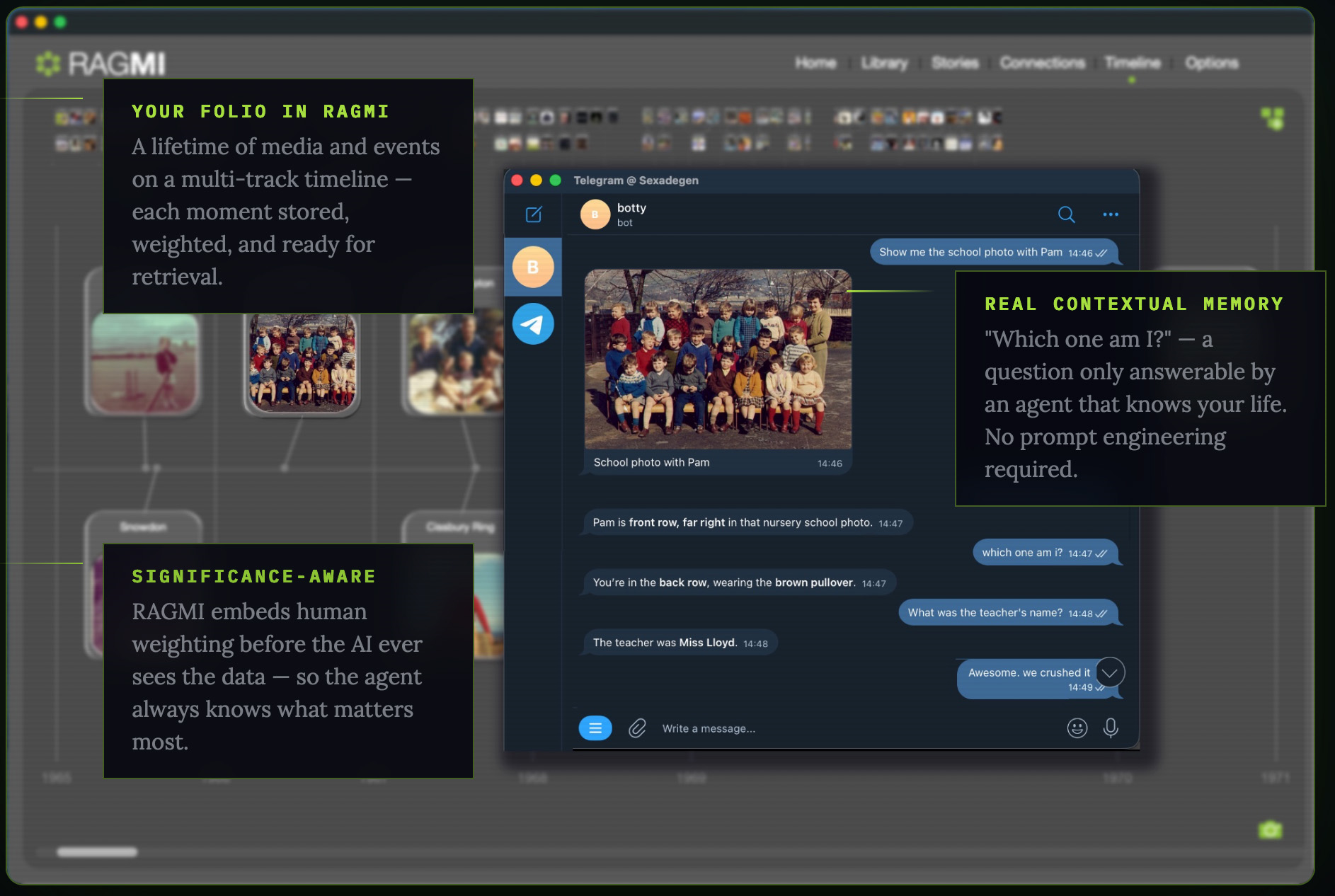
The screenshot above shows this in practice: an agent connected to a RAGMI folio via OpenClaw, identifying a person in a childhood school photograph, naming their position in the class photo, and providing context no general-purpose AI could have reached. Not because it was trained on that photograph. Because the folio was structured so the agent could reason with it.
Why structure matters more than volume
This is where the Human Context Protocol becomes important. Most AI context is flat text — a document the model reads and partially retains. HCP is different. Every person in a folio carries a proximity score reflecting their place in your life. Every event carries a significance weighting. Every relationship has a description of what it meant, not just what it was.
When an AI agent queries a folio, it isn't searching a document. It's reasoning across a structured knowledge graph — one where the most important things are marked as such, and where the connections between people and events are explicit rather than implied. The result is an agent that can answer questions a flat document never could: not just what happened, but what it meant; not just who someone was, but how central they were to the life being described.
This is why a folio built with the HCP structure is fundamentally different from a memoir saved as a PDF. The PDF might contain more words. The folio contains more meaning — in a form a machine can actually use.
The question of permanence
There is a longer dimension to this that is worth thinking about. The AI agents available today are already remarkable. The agents available in ten years will be unrecognisable by comparison. A folio built now — built properly, in an open and structured format — will become more useful over time, not less. Each new generation of AI will be able to do more with the same structured context than the generation before it.
The inverse is also true. A life story captured as flat text, or not captured at all, cannot be recovered and restructured later. The memories that haven't been recorded, the relationships that haven't been described, the significance weightings that only the person themselves could have assigned — once that person is gone, they cannot be reconstructed. The window for building the folio exists only while the person who knows it is still here to build it.
RAG, then, is not just a way of making today's AI more personal. It is the architecture for a form of memory that outlasts the person who holds it — accessible to their family, usable by the AI agents of the future, and permanent in a way that no photograph album or box of letters can be.
What this makes possible
A folio connected to an AI agent via Human RAG is the beginning of something that doesn't have a good name yet. It isn't quite a digital twin. It isn't an archive. It's closer to a structured presence — a representation of a person that an AI can reason with on behalf of the people who loved them, long after the person themselves is gone.
A grandchild who never met their grandmother can ask an agent what she was like at their age, and get an answer grounded in her actual memories, her actual words, the significance she assigned to the events of her own life. That is what Human RAG makes possible. Not general knowledge about the world. Specific knowledge about a life.
That, in the end, is what this technology is for.